Avoiding scalding danger with recirculation
Every year in the United States, an average of 100,000 people seek medical treatment for thermal scald burns. We covered this issue a decade ago. Sadly, not much has changed with respect to protecting the health of the nation where scalding is concerned.
While bathing nodule faucets still require scald-guard protection, plumbing codes governing installation of tank-style water heaters still do not require we provide and install a TMV (thermostatic mixing valve) to regulate outgoing DHW (domestic hot water) temperatures. Manufacturers of tank-style water heaters have been more proactive and stepped up by providing add-on, easy-to-install and inexpensive TMV kits.
As was the case in 2002, thermal stacking is permitted by code to rise 30°F above the thermostat’s set-point: a 120°F setting can rise to 150°F and still be code compliant! In addition, homeowners still fiddle with thermostat settings, especially if they have been running out of hot water (got teenagers?), which can result in the thermostat being set to 160°F. Add 30°F to that and extreme danger for thermal scalding exists.
Walk the talk
A reader recently asked me about my home’s gravity recirculation and the use of a TMV. When I added thermal solar to my home’s DHW system, it was apparent we would see a wide range of DHW storage temperatures: from mildly warm (cloudy weather) to blistering hot (we’ve seen 190°F at times). I installed a Watts ASSE 1017 TMV on the outlet of both my solar and indirect water heating tanks without altering my existing gravity return (flow-check with small-diameter hole drilled in the check’s gate) and had been monitoring the results. Gravity flow is much slower than forced flow using a circulator, and, during any time DHW is not being utilized at a point of use, its return-water creeps up through the tank’s dip tube in reverse flow to reach the thermostatic mix valve.
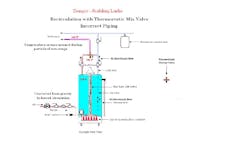
In the “Danger – Scalding Lurks” drawing, incoming cold water can flow both to the TMV and into the tank through the dip tube.
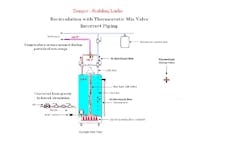
However, if no DHW is being drawn at a point of use, no cold water will be available to the TMV and it must draw from the tank via the dip tube. Note the bi-directional arrows drawn at the dip tube and CW inlet. While my return water was 10°F cooler than my outgoing mixed to 120°F DHW supply-line, the 140°F tank-storage temperature was constantly heating the 110°F return water as it rose up through the internal dip tube. As a result, my DHW supply would rise upwards well past the 120°F set at the thermostatic mix-valve during long periods of no use (overnight or vacation).
To further experiment, I added a bronze circulator (see Scalding Lurks drawing) in the existing gravity return line and adjusted the TMV to several settings: 110°F; 120°F; and 133°F, while observing the outgoind DHW temperatures during high flow (showers) and low flow (lavatory). As long as a DHW draw existed, and for hours afterwards, the TMV adjusted automatically to hold the temperature setting. However, by morning, after eight hours of no DHW usage, the temperature was close to, or equal to, the tank’s storage temperature of 140°F. Thermal creep had set up an increased danger for thermal scalding. Do this in a customer’s home and liability can come creeping into your world!
The correct way
An “expert” in piping hydronic systems suggested I should add a second TMV and connect its cold-inlet side to the existing gravity return and its hot-inlet below the existing TMV while leaving the circulator where I had it installed. Its mixed-temperature outlet would tie into the 120°F supply line to all points of use. While that would work, there is a better way that saves time and money.
I moved the gravity return to tie onto the cold inlet side of the TMV. Gravity flow was slowed by the increased height above the tank’s drain-valve (reduced the distance between upper and lower temperature stratification) and, at times, was leaving us with a wait for hot water at the fartherest most remote fixture – our master bath shower. Not acceptable!
What you see in the final Correct Piping drawing illustrates what we now have and a safer way to provide recirculation of DHW.
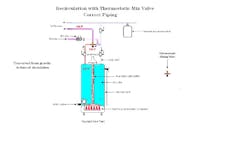
You can use timed, on-demand, or constant circulation. When the circulator is off there is no flow due to the circulator’s IFC (internal flow check). The tank is no longer in-line with the recirculation loop and its internal temperature can safely be set to assist with bacterial pasteurization (above 133°F). Given my research regarding Legionella bacteria, we utilize 24/7/365 circulation to avoid stagnation. The constant circulation costs me an additional four cents per day for power over what we would pay for timed circulation.
All Dave Yates material in print and on Contractor's Website is protected by Copyright 2012. Any reuse of this material (print or electronic) must first have the expressed written permission of Dave Yates and Contractor magazine. Please contact via email at: [email protected].
About the Author
Dave Yates
Dave Yates material in print and on Contractor’s Website is protected by Copyright 2017. Any reuse of this material (print or electronic) must first have the expressed written permission of Dave Yates and Contractor magazine.