Chicago public schools district builds green
CHICAGO — Chicago Public Schools (CPS) has a commitment to build sustainable and be sustainable — the district has built six U.S. Green Building Council LEED certified schools and one addition in the past five years, and will continue to build new buildings that meet The Chicago Standard, the city's building standard that is based on LEED points. The CPS also has an Environmental Action Plan, which all schools, old and new, are following.
In 2004, The Chicago Standard, which includes green building standards, for city facilities was implemented. The standards are based on selected LEED points that make sense for Chicago, conserving water and decreasing energy costs, among other beneficial outcomes. Once the city adapted the new set of green construction standards, CPS followed the prescribed requirements for new buildings and renovations, and also came up with an Environmental Action Plan.
“CPS had been on board from the beginning,” said Mark Bishop, the deputy director of Healthy Schools Campaign, a not-for-profit organization for healthy school environments. “They have taken this issue and took lead of the mayor, creating a task force to identify standards and they have been ahead of the game. It's great to be able to walk into some of these green schools.”
The first school to open was Tarkington School of Excellence in 2005, built by the Public Building Commission of Chicago, obtaining LEED certification, and since then, the CPS increased its commitment to build sustainable — all five schools and the addition that the CPS and PBC opened this fall target USGBC Silver certification. In fact, all of the Public Building Commission's projects — which include schools, branch libraries, firehouses and police stations — are designed to achieve Silver certification or better.
According to Suzanne Carlson, director of environmental affairs at CPS, building modeling is done so all new schools are built according to a baseline and they are designed to meet a higher performance standard. Building sustainably, however, is a new venture for CPS, so energy efficiency data is not available yet.
In order to receive USGBC LEED certification, sustainable systems have been installed in the new schools. At Westinghouse High School, a solar thermal system heats water, contributing to energy efficiency; a reflective roof reduces the urban heat island effect; low-flow plumbing fixtures and sensor lavatory faucets conserve water; and a stormwater management plan decreases the rate of stormwater runoff.
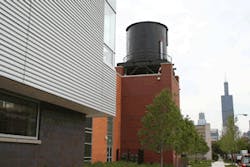
At Dr. Jorge Prieto Math and Science Academy, the roof is reflective to decrease the urban heat island effect, and low-flow plumbing fixtures and sensor sinks will contribute to water conservation. Langston Hughes Elementary School and Irene C. Hernandez Middle School also have a reflective roof and water-efficient plumbing fixtures. At Mark T. Skinner West Elementary School, a historic water tower is being used to store rainwater for landscape irrigation, and other sustainable features at the school include efficient plumbing fixtures and a reflective roof. The addition to Peterson Elementary School utilizes a ground-source heat pump system.
Photovoltaic systems are another green technology CPS would like to use in new schools, but none of the new schools have solar because of the expense, according to Carlson.
“For solar, grant funds are usually needed,” explained Carlson. “We do have 12 schools with photovoltaics, but they are existing buildings. None of the new buildings are PV at this time, but they are in the design. If we can't fit it into the budget, we can look for grant sources to add solar later.”
At Northside College Prep, one of the older schools, a solar thermal system for the pool will be installed soon. CPS and two grants will finance the pool project.
Environmental plan
CPS has an Environmental Action Plan that was developed in 2008. For the first time this year, sustainable strategies were implemented to reduce energy usage, improve indoor air quality, reduce contribution to climate change, and increase use of renewable energy and reduce waste. Conserving water will most likely be added to the plan soon.
“The first year we did this, we came up with things that could be actionable short term items and highest priorities,” said Carlson. “CPS doesn't pay for water, so at first it was best to pick things like energy use, so we could see a payback. This year it would make sense to add water.“
At the moment, CPS is implementing stormwater management systems, and the next step should be reducing fresh water consumption, according to Carlson.
“The Environmental Action Plan is important because it reduces CPS impact on the environment,” said Carlson. “We have 700 facilities, so we are a big consumer of energy and materials, so there are things we can do to reduce our impact on the environment. Some of the things we took on have a financial benefit, so if we reduce energy use, we can put the money saved back into education.”
About the Author
Candace Roulo
Candace Roulo, senior editor of CONTRACTOR and graduate of Michigan State University’s College of Communication Arts & Sciences, has 15 years of industry experience in the media and construction industries. She covers a variety of mechanical contracting topics, from sustainable construction practices and policy issues affecting contractors to continuing education for industry professionals and the best business practices that contractors can implement to run successful businesses.